Can Humans Travel to Another Galaxy? The Science of Reaching Andromeda
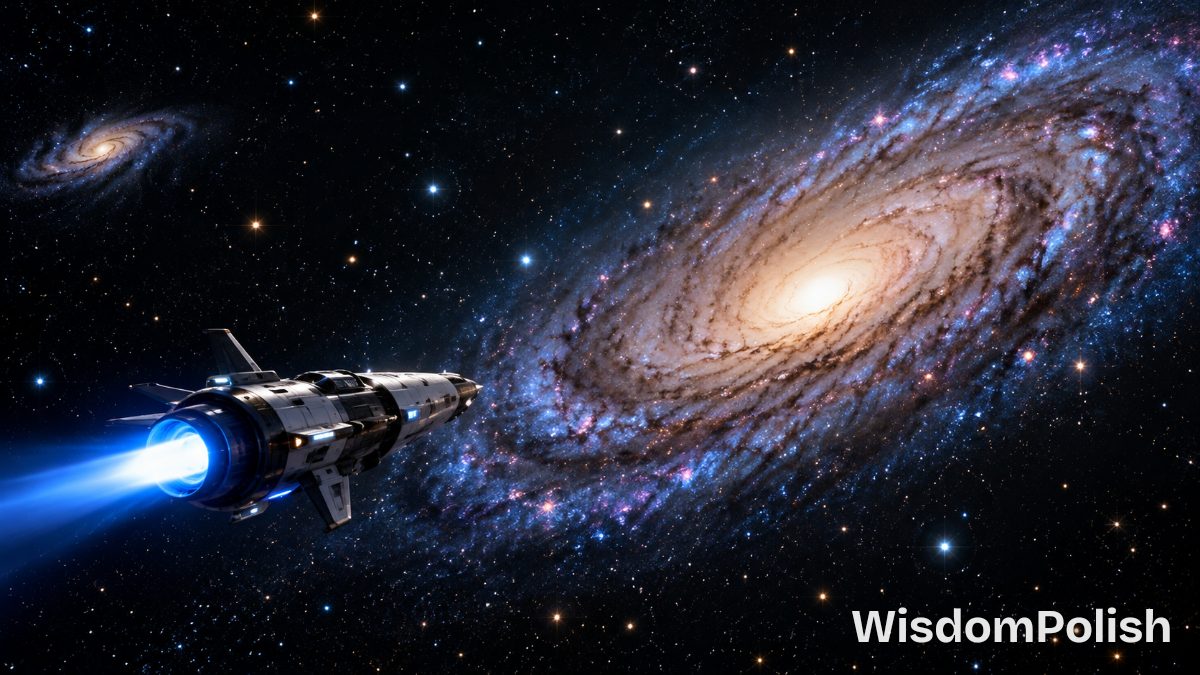
Can Humans Travel to Another Galaxy? The Science of Reaching Andromeda
Imagine boarding a spacecraft, leaving Earth behind, passing beyond the Solar System, and continuing through the darkness of space until you reach an entirely different galaxy.
It sounds like something from a science fiction movie. But is it actually possible?
Scientists have already sent spacecraft beyond the planets of our Solar System. Astronomers have also discovered countless galaxies throughout the observable universe. Yet traveling from one galaxy to another presents challenges far greater than anything humanity has overcome so far.
One of the most fascinating destinations is the Andromeda Galaxy, our nearest major galactic neighbor. Located approximately 2.5 million light-years from Earth, Andromeda contains an enormous population of stars and planetary systems.
However, reaching it would require technologies and travel capabilities that humans do not currently possess.
So, how could humanity eventually travel to another galaxy? How long would the journey take? And could future generations ever make such a trip?
Let's explore the science behind intergalactic travel.
1. WHICH GALAXY IS CLOSEST TO THE MILKY WAY?
Earth is located inside the Milky Way, a spiral galaxy containing vast numbers of stars, gas clouds, dust, and planetary systems.
Beyond the Milky Way, several smaller galaxies exist in our cosmic neighborhood. Some are satellite galaxies associated with the Milky Way, while others belong to the wider Local Group of galaxies.
The Andromeda Galaxy, also known as Messier 31 or M31, is the nearest major galaxy to our own. It lies approximately 2.5 million light-years away.
A light-year is the distance light travels in one year, approximately 9.46 trillion kilometers.
Therefore, traveling to Andromeda would mean crossing an immense distance of roughly 23.7 quintillion kilometers.
Even traveling at extraordinary speeds, a spacecraft would need an enormous amount of time to complete the journey.
Andromeda is not simply another star system. It is a vast collection of stars, planetary systems, gas, dust, and other astronomical objects.
Reaching it would be one of the greatest transportation challenges imaginable.
2. WHY CAN'T WE SIMPLY BUILD A FASTER ROCKET?
Modern rockets are powerful enough to send robotic spacecraft beyond Earth and toward distant planets.
However, conventional rockets are not designed for journeys lasting millions of years.
The main problem is speed.
Spacecraft travel at impressive speeds by human standards, but the distances between galaxies are so enormous that even our fastest existing spacecraft would take far too long to reach Andromeda.
For example, NASA's Voyager 1 spacecraft travels through space at approximately 61,000 kilometers per hour. It was launched in 1977 and has traveled beyond the planets of our Solar System.
At that approximate speed, a hypothetical journey to Andromeda would take around 44 billion years, assuming a constant speed throughout the journey.
This is a simplified estimate that does not account for acceleration, deceleration, or other practical challenges.
For comparison, the universe is approximately 13.8 billion years old.
In other words, a journey to Andromeda at Voyager 1's approximate speed would take several times the current age of the universe.
Clearly, conventional spacecraft are not a practical solution for intergalactic travel.
Humanity would need a fundamentally different approach.
3. COULD HUMANS TRAVEL AT THE SPEED OF LIGHT?
One obvious idea is to build a spacecraft capable of traveling at the speed of light.
Light travels through a vacuum at approximately 300,000 kilometers per second.
At that speed, light from Andromeda takes approximately 2.5 million years to reach Earth.
Therefore, even a hypothetical journey at the speed of light would require approximately 2.5 million years as measured by an observer on Earth.
Unfortunately, there is a major problem.
According to Einstein's theory of special relativity, an object with mass cannot be accelerated to the speed of light because doing so would require an unlimited amount of energy.
A spacecraft carrying humans has mass, meaning it cannot reach the speed of light under our current understanding of physics.
However, there is an interesting possibility.
A spacecraft could theoretically travel at a speed very close to the speed of light.
At such speeds, time dilation becomes significant. Time would pass differently for the traveling crew compared with people remaining on Earth.
Under idealized conditions, the travelers could experience substantially less time than observers on Earth.
The closer the spacecraft approached the speed of light, the greater this difference could become.
But reaching and maintaining such speeds would require extraordinary amounts of energy, advanced propulsion systems, protection against dangerous radiation, and solutions to many other engineering challenges.
Although time dilation is established physics, building a spacecraft capable of carrying humans across intergalactic distances at relativistic speeds remains far beyond our present capabilities.
4. COULD NUCLEAR PROPULSION MAKE INTERGALACTIC TRAVEL POSSIBLE?
One possible direction for future space exploration is nuclear propulsion.
Unlike conventional chemical rockets, which release energy through chemical reactions, nuclear propulsion systems aim to use energy from nuclear reactions to improve spacecraft performance.
Several different approaches have been studied, including nuclear thermal propulsion and nuclear electric propulsion.
Nuclear thermal rockets would heat a propellant using a nuclear reactor before expelling it to produce thrust.
Nuclear electric systems would use nuclear power to operate electric propulsion devices.
These technologies could potentially improve the performance of some future missions within our Solar System.
However, they do not automatically solve the problem of traveling to another galaxy.
Even a substantial improvement in spacecraft speed would leave an enormous gap between present-day propulsion systems and the speeds required for practical intergalactic travel.
More advanced concepts, such as fusion propulsion, have also been explored by researchers.
Fusion reactions could theoretically provide substantial energy, but developing a practical spacecraft engine capable of using fusion for sustained high-speed travel remains an unresolved engineering challenge.
For now, nuclear propulsion is an area of research that could improve future space exploration, rather than an established method for reaching other galaxies.
5. COULD LASER-POWERED LIGHT SAILS TAKE US TO ANOTHER STAR SYSTEM?
Another fascinating idea is the light sail.
A light sail is a large, lightweight reflective surface that receives momentum from light.
Although the force exerted by light is extremely small, it can potentially accelerate a sufficiently lightweight spacecraft over time.
One proposed approach involves powerful lasers on or near Earth directing energy toward a tiny spacecraft equipped with a light sail.
The concept is associated with research into missions that could eventually travel to nearby star systems.
A successful mission of this kind could help scientists investigate whether extremely lightweight probes can reach a meaningful fraction of the speed of light.
However, this idea remains experimental, and no laser-powered spacecraft has yet demonstrated the ability to carry out such an interstellar journey.
There is also a crucial distinction between interstellar and intergalactic travel.
Interstellar travel means traveling between stars within a galaxy.
Intergalactic travel means traveling between galaxies.
Even a spacecraft moving at 20 percent of the speed of light would require approximately 12.5 million years to cross the distance to Andromeda, measured by an observer on Earth.
That is far beyond the timescale of an ordinary human mission.
Light sails could potentially help humanity explore nearby stars in the distant future, but reaching another galaxy would remain a vastly greater challenge.
6. WHAT ABOUT WORMHOLES AND WARP DRIVES?
Science fiction frequently depicts spacecraft traveling between distant galaxies through wormholes or warp drives.
These concepts have connections to mathematical solutions studied in theoretical physics, but that does not mean they can currently be built.
A wormhole is a hypothetical structure that could connect distant regions of spacetime.
If a traversable wormhole existed and could be controlled, it might provide a shortcut between otherwise distant locations.
However, scientists have not discovered a usable wormhole, and there is no demonstrated method for creating or stabilizing one.
Some theoretical wormhole models require unusual physical conditions, including forms of negative energy whose practical availability and behavior remain uncertain.
Warp-drive concepts are also based on speculative solutions to equations in general relativity.
One frequently discussed idea involves changing the geometry of spacetime around a spacecraft rather than simply accelerating the spacecraft through space in the usual way.
But these proposals face substantial theoretical and practical obstacles, including extreme energy requirements and unresolved questions about whether physically realizable configurations are possible.
At present, neither wormholes nor warp drives provide a proven method of intergalactic transportation.
They remain subjects of theoretical investigation and scientific speculation.
7. COULD HUMANS SURVIVE A JOURNEY LASTING MILLIONS OF YEARS?
Even if engineers developed a spacecraft capable of traveling toward another galaxy, transporting human beings would introduce additional problems.
Human bodies are adapted to life on Earth, not millions of years in deep space.
A spacecraft traveling for an extremely long period would need to protect its occupants from radiation, maintain breathable air, provide food and water, manage waste, and keep essential systems operating.
One proposed solution is a generation ship.
A generation ship would be a spacecraft designed to support a population over many generations.
The original crew would not reach the destination during their lifetime. Instead, their descendants would continue the journey.
Such a spacecraft would need a reliable ecosystem, advanced medical facilities, sufficient resources, and social structures capable of supporting a stable population over extremely long periods.
Another possibility is suspended animation, in which biological processes are slowed enough to reduce the demands of a long journey.
However, safely placing humans into a reversible state of deep hibernation for centuries or millions of years is not currently possible.
Even if these challenges were eventually solved, a generation ship traveling to Andromeda would still face the extraordinary difficulty of maintaining its systems across a journey lasting millions of years.
The concept is scientifically interesting, but it remains speculative.
8. WHAT WOULD HAPPEN IF THE MILKY WAY AND ANDROMEDA MEET?
There is another fascinating fact about our destination.
The Andromeda Galaxy is moving toward the Milky Way under their mutual gravitational attraction.
Astronomers have studied the motions of these galaxies to understand their future interactions.
Earlier NASA analyses suggested a likely collision several billion years in the future. However, more recent research has shown that the precise outcome is uncertain, and a direct collision is not guaranteed.
If the two galaxies eventually merge, their structures will change dramatically.
Their gravitational fields will influence the motion of stars and gas, and the interaction could trigger new episodes of star formation.
Despite the dramatic name, a galactic collision does not mean that every star will crash into another star.
The distances between stars are so enormous that direct stellar collisions are expected to be rare.
Our Solar System's exact future position and fate would depend on how the encounter unfolds.
This potential future merger is an extraordinary example of how galaxies evolve over billions of years.
It also reminds us that galaxies are not stationary objects. They move, interact, and change over cosmic timescales.
9. IS INTERGALACTIC TRAVEL ACTUALLY POSSIBLE?
The honest answer is that we do not currently know whether humans will ever develop a practical way to travel to another galaxy.
What we do know is that several important barriers stand in the way.
First, the distances are enormous.
Second, known propulsion technologies cannot transport humans across those distances within a practical timeframe.
Third, the energy requirements for near-light-speed travel would be extraordinary.
Fourth, protecting human passengers and spacecraft systems over such journeys would introduce major engineering and biological challenges.
Finally, ideas such as traversable wormholes and warp drives have not been demonstrated as practical technologies.
None of these facts proves that every conceivable future method of intergalactic travel is impossible.
However, it would be misleading to suggest that scientists already have a working plan to send humans to Andromeda.
The most realistic near-term goals involve exploring our Solar System, improving spacecraft propulsion, studying nearby stars, and developing technologies that could make interstellar missions more feasible.
Each step would expand our understanding of what is possible.
10. COULD FUTURE HUMANS EVER REACH ANDROMEDA?
Imagine humanity surviving for thousands, millions, or even billions of years.
Future civilizations might develop technologies that seem unimaginable to us today.
They could discover new propulsion methods, learn more about the fundamental properties of spacetime, or find ways to sustain life during extremely long journeys.
Perhaps humanity will eventually send robotic explorers toward distant galaxies.
Perhaps future generations will discover that some of today's theoretical ideas cannot work, while other approaches prove more promising.
At present, we cannot predict which possibilities will become reality.
Scientific progress depends on evidence, experimentation, and a willingness to revise our assumptions.
The most important point is that the universe still contains enormous unanswered questions.
Andromeda is visible from Earth under sufficiently dark skies, yet the distance separating us from it is so vast that even light requires millions of years to cross it.
That contrast captures the extraordinary scale of the cosmos.
We can observe another galaxy, study its stars, and investigate its history without ever traveling there.
For now, telescopes and robotic spacecraft remain our most practical tools for exploring the wider universe.
Future discoveries may expand those possibilities, but intergalactic travel remains one of humanity's greatest scientific challenges.
FREQUENTLY ASKED QUESTIONS
How far away is the Andromeda Galaxy?
The Andromeda Galaxy is approximately 2.5 million light-years from Earth. It is the nearest major galaxy to the Milky Way.
How long would it take to reach Andromeda?
The answer depends on the spacecraft's speed. At the approximate speed of Voyager 1, the journey would take around 44 billion years under a simplified constant-speed calculation. At the speed of light, the distance corresponds to approximately 2.5 million years for an observer on Earth.
Can humans travel faster than light?
According to our current understanding of physics, an object with mass cannot be accelerated to the speed of light. Faster-than-light travel remains speculative, and no practical method has been demonstrated.
Could a wormhole take us to another galaxy?
A traversable wormhole could theoretically provide a shortcut through spacetime. However, no usable wormhole has been discovered, and scientists do not know how to create or stabilize one.
Is NASA planning a mission to Andromeda?
There is no operational NASA mission designed to transport humans or spacecraft to Andromeda. The galaxy is currently studied using astronomical observations and telescopes.
Will the Milky Way collide with Andromeda?
The galaxies are approaching one another, but the precise outcome of their future encounter remains uncertain. Their interaction is expected to take place on a timescale of billions of years.
FINAL THOUGHTS
Traveling to another galaxy is one of the most ambitious ideas humanity can imagine.
The Andromeda Galaxy is our nearest major galactic neighbor, yet it lies approximately 2.5 million light-years away.
Conventional rockets are nowhere near fast enough to make the journey practical. Near-light-speed spacecraft, nuclear fusion propulsion, generation ships, wormholes, and warp drives each present different possibilities or challenges, but none currently offers a proven way to transport humans to another galaxy.
For now, our greatest achievement is learning how the universe works through scientific observation and exploration.
Perhaps future civilizations will discover new ways to cross the immense distances between galaxies. Until then, Andromeda remains both a real astronomical destination and a powerful reminder of how much there is left to discover.
The universe is vast, and our journey to understand it has only just begun.
MEDICAL OR SCIENTIFIC DISCLAIMER
This article is intended for educational purposes. Scientific predictions and theoretical propulsion concepts are discussed based on current scientific understanding. Speculative technologies should not be interpreted as proven methods of space travel.
Comments
No comments yet. Be the first.
Leave a comment
Comments appear after they are approved.