How Fast Is the Speed of Light? The Amazing Science Behind the Universe's Ultimate Speed Limit
How Fast Is the Speed of Light? The Amazing Science Behind the Universe's Ultimate Speed Limit
Every time we look at the night sky, we are looking into the past.
The light from some distant stars may have traveled for hundreds or even thousands of years before reaching our eyes. Yet light itself moves at an astonishing speed that is difficult for the human mind to imagine.
So, exactly how fast is light?
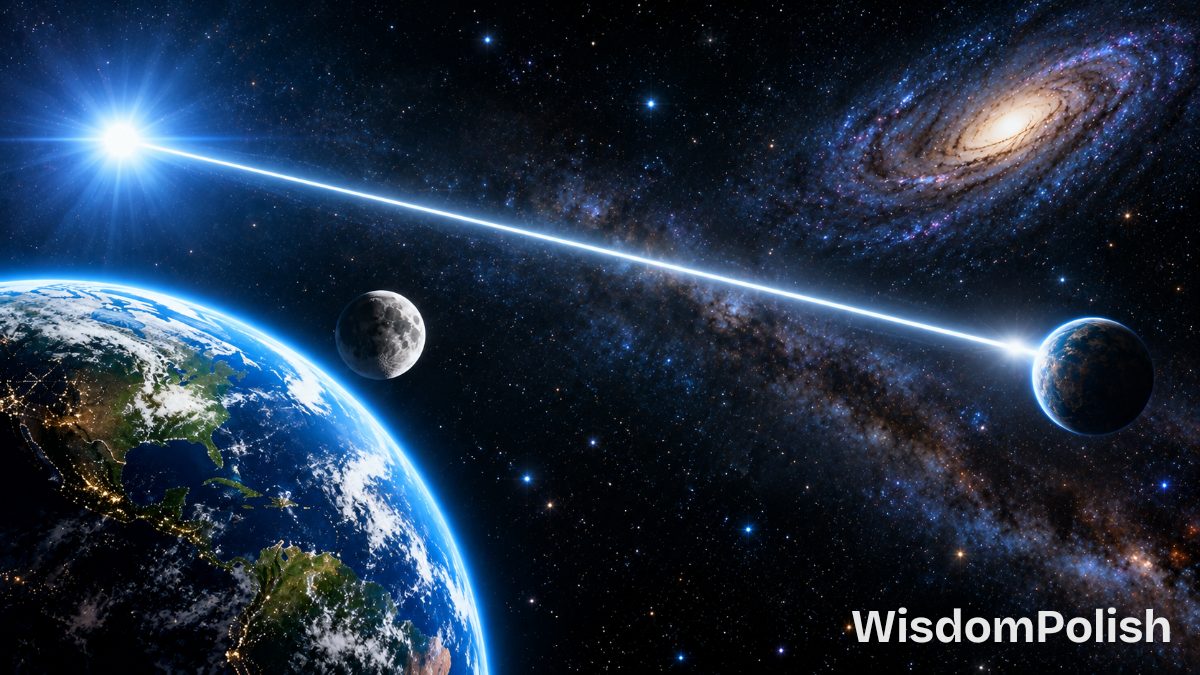
In a vacuum, light travels at approximately 299,792 kilometers per second. At that speed, it could circle Earth more than seven times in a single second.
Light can travel from Earth to the Moon in approximately 1.3 seconds, while sunlight takes about 8 minutes and 20 seconds to reach our planet.
But the speed of light is much more than an impressive number. It is a fundamental constant of nature that helps scientists understand space, time, gravity, and the structure of the universe.
In this article, we explore the science behind the speed of light and discover why it plays such an important role in modern physics.
1. WHAT IS THE SPEED OF LIGHT?
In a vacuum, light travels at exactly 299,792,458 meters per second.
This is approximately 299,792 kilometers per second, or about 300,000 kilometers per second when rounded.
Scientists represent the speed of light in a vacuum using the symbol c.
To understand just how fast this is, consider a few examples.
Light can travel around Earth's circumference in less than one-tenth of a second.
It takes approximately 1.3 seconds for light to travel from Earth to the Moon.
Sunlight takes approximately 8 minutes and 20 seconds to reach Earth.
Depending on the positions of Earth and Mars, a signal traveling at the speed of light can take several minutes to more than 20 minutes to travel between the two planets.
These examples demonstrate that light is incredibly fast, yet distances in space are so enormous that even light needs time to cross them.
2. WHO DISCOVERED THE SPEED OF LIGHT?
For centuries, scientists debated whether light traveled instantaneously or required time to move from one place to another.
In the seventeenth century, Danish astronomer Ole Rømer studied the eclipses of Io, one of Jupiter's moons.
His observations provided important evidence that light travels at a finite speed.
Later scientists developed increasingly accurate methods for measuring the speed of light.
During the nineteenth century, experiments conducted by researchers including Albert A. Michelson helped improve these measurements.
Today, the speed of light in a vacuum has an exact defined value within the International System of Units.
In 1983, the meter was redefined using the distance that light travels in a vacuum during a specified fraction of a second.
As a result, the speed of light in a vacuum is defined as exactly 299,792,458 meters per second.
This precise value is one of the foundations of modern measurement science.
3. CAN ANYTHING TRAVEL FASTER THAN LIGHT?
One of the most fascinating questions in physics is whether anything can travel faster than light.
According to Albert Einstein's special theory of relativity, the speed of light in a vacuum is a fundamental speed limit for objects with mass.
Imagine trying to accelerate a spacecraft until it reaches the speed of light.
As the spacecraft's speed approaches the speed of light, the energy required to accelerate it further increases dramatically.
Reaching the speed of light would require unlimited energy under the standard framework of special relativity.
For this reason, a spacecraft with mass cannot reach the speed of light.
However, this does not mean that every phenomenon in the universe follows the same simple rule in every context.
For example, the expansion of space between extremely distant regions of the universe is described differently from the motion of an ordinary spacecraft through space.
Quantum entanglement also produces correlations between distant particles, but it does not allow usable information to be transmitted faster than light.
Under our current understanding of physics, there is no demonstrated method for sending ordinary objects or information faster than light through space.
4. WHAT HAPPENS TO TIME WHEN YOU APPROACH THE SPEED OF LIGHT?
One of the strangest consequences of Einstein's theory is time dilation.
Time dilation means that observers moving relative to one another can measure different amounts of elapsed time between events.
Imagine a spacecraft traveling at a speed extremely close to the speed of light.
The crew aboard the spacecraft could experience less elapsed time than people remaining on Earth.
For example, a journey that lasts a relatively short time for the traveling crew could correspond to a much longer period on Earth, depending on the spacecraft's speed and journey.
This is not simply a science-fiction idea. Time dilation is an established physical effect that has been confirmed experimentally.
It must be considered in systems involving precise atomic clocks, fast-moving particles, and satellite navigation technologies such as GPS.
However, time dilation does not mean that humans can travel at the speed of light.
It explains how time behaves differently under conditions involving very high relative speeds.
5. ARE WE SEEING THE SUN AS IT WAS IN THE PAST?
Yes.
The average distance between Earth and the Sun is approximately 150 million kilometers.
Although light travels incredibly fast, it still takes approximately 8 minutes and 20 seconds to cover that distance.
This means that when we look at the Sun, we see the light it emitted about eight minutes earlier.
If the Sun suddenly changed in some way, that change could not be observed from Earth until the resulting light reached us.
The same principle applies to distant stars and galaxies.
For example, if a star is 100 light-years away, the light reaching Earth today left that star approximately 100 years ago.
When astronomers observe distant galaxies, they are therefore studying light that began its journey long before the present day.
This is one of the reasons telescopes allow scientists to investigate the history and evolution of the universe.
6. IS A LIGHT-YEAR A UNIT OF TIME OR DISTANCE?
Despite its name, a light-year is a unit of distance, not time.
One light-year is the distance light travels through a vacuum in one year.
That distance is approximately 9.46 trillion kilometers.
Astronomers use light-years because distances between stars and galaxies are too large to express conveniently using ordinary measurements.
For example, the Alpha Centauri star system, our nearest stellar neighbor beyond the Sun, is approximately 4.3 light-years away.
Light from that system takes more than four years to reach Earth.
Using light-years makes it much easier to describe the enormous distances involved in astronomy.
7. CAN LIGHT BE SLOWED DOWN?
In a vacuum, light travels at its maximum speed.
However, when light passes through materials such as water or glass, its propagation speed is lower than its speed in a vacuum.
This happens because light interacts with the material through which it travels.
Under specially designed experimental conditions, scientists can also manipulate the propagation of light pulses in unusual ways.
Some experiments have demonstrated extremely slow light pulses in carefully prepared systems.
However, this does not mean that the fundamental speed of light in a vacuum has changed.
Nor does slowing light inside a material allow ordinary objects or usable information to exceed the speed of light in a vacuum.
The distinction between light's behavior inside matter and its speed in a vacuum is essential for understanding optics and modern physics.
8. WHY IS THE SPEED OF LIGHT IMPORTANT IN EVERYDAY LIFE?
The speed of light is not merely an abstract scientific concept.
It plays an important role in many modern technologies.
GPS navigation is one example.
GPS satellites carry highly precise clocks and move around Earth at high speeds.
Both their motion and the gravitational environment affect how their clocks compare with clocks on the ground.
Engineers must account for these relativistic effects to maintain accurate positioning.
Without the necessary corrections, GPS calculations would gradually develop significant errors.
The principles governing light and electromagnetic waves are also important for fiber-optic communications, radar, satellite links, and many other technologies.
Much of modern communication depends on our understanding of how electromagnetic signals travel.
9. CAN LIGHT REACH THE EDGE OF THE UNIVERSE?
This question reveals another remarkable feature of cosmology.
The universe is approximately 13.8 billion years old, yet the radius of the observable universe is estimated to be about 46.5 billion light-years.
At first, these numbers may seem contradictory.
If the universe is 13.8 billion years old, how can we observe regions that are now more than 13.8 billion light-years away?
The answer is the expansion of the universe.
While light was traveling toward us, space itself expanded.
As a result, the distance between the region where the light originated and its present location can be much greater than the distance the light would have covered in a static universe.
The observable universe represents the region from which information has had time to reach us.
It does not necessarily represent the entire universe.
Scientists do not yet know whether the complete universe is finite or infinite.
This is an important reminder that the observable cosmos may be only part of a much larger reality.
10. WHAT DOES THE SPEED OF LIGHT TELL US ABOUT THE UNIVERSE?
The speed of light is one of the most important constants in modern physics.
It connects our understanding of space and time and helps explain how the universe behaves at very high speeds and across enormous distances.
It also establishes a fundamental limit on how quickly information can travel locally through space under our current understanding of physics.
Although light can cross the distance between Earth and the Moon in just over a second, it takes millions of years for light from some distant galaxies to reach us.
This difference illustrates the extraordinary scale of the universe.
The speed of light also reminds us that observing distant objects means studying their past.
Every telescope provides a window into cosmic history, allowing astronomers to investigate how stars, galaxies, and the universe itself have changed over time.
FINAL THOUGHTS
The speed of light is far more than a number used in physics textbooks.
It is a fundamental feature of the universe that shapes our understanding of time, space, gravity, communication, and astronomy.
Traveling at nearly 300,000 kilometers per second, light can cross the distance between Earth and the Moon in about 1.3 seconds. Yet it takes millions of years for light from distant galaxies to reach our planet.
According to our current understanding of physics, an object with mass cannot reach the speed of light.
However, this limitation has not stopped scientists from exploring the universe and developing new technologies.
Through telescopes, spacecraft, and scientific experiments, humanity continues to discover new facts about the cosmos.
The more we learn about the speed of light, the more clearly we understand both the remarkable laws governing the universe and the enormous number of questions that remain unanswered.
Comments
No comments yet. Be the first.
Leave a comment
Comments appear after they are approved.